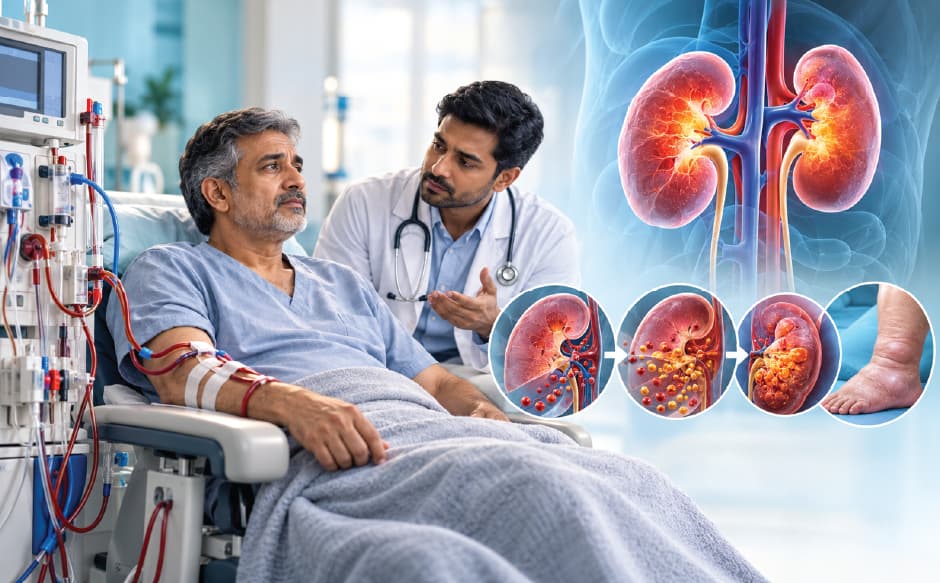

Your kidneys filter waste from your blood every single day, a job so vital that most people never think about it, until something goes wrong. Two conditions often confused are acute kidney injury (AKI) and chronic kidney disease (CKD), but they are very different in how they develop, what causes them, and how doctors treat them.
This guide breaks down what separates AKI from CKD, how each develops, how doctors tell them apart on paper, whether one can turn into the other, and what treatment actually looks like at a Kolkata hospital equipped to manage both.
What Is Acute Kidney Injury (AKI)?
Acute kidney injury, once called acute renal failure, is a sudden drop in kidney function that develops over hours to a few days. Nephrologists classify its severity using the KDIGO criteria, which track how much serum creatinine rises or how much urine output falls in a short window. The key clinical detail that separates AKI from CKD is speed: something goes wrong with the kidneys' blood supply, filtering units, or drainage, and it happens fast enough that the body hasn't had time to compensate.
Common Causes of AKI
-
Severe dehydration or major blood loss (reduced blood flow to the kidneys)
-
Sepsis or a serious infection
-
Major surgery, trauma, or burns
-
Nephrotoxic medicines, certain antibiotics, NSAIDs, contrast dye used in imaging
-
A blocked urinary tract, commonly from kidney stones or an enlarged prostate.
Warning Signs You Shouldn't Ignore
-
A sudden, noticeable drop in how much you're urinating
-
Swelling in the legs, ankles, or around the eyes that appears over a day or two
-
Breathlessness, confusion, or unusual fatigue during or after an illness/surgery
-
Nausea and a metallic taste, especially in someone already hospitalised
Because AKI usually shows up in people already unwell or hospitalised, it's often caught through routine blood tests before symptoms become obvious, which is exactly why regular monitoring during any serious illness or surgery matters.
What Is Chronic Kidney Disease (CKD)?
Chronic kidney disease is a gradual, usually permanent, decline in kidney function that develops over three months or longer. Doctors stage CKD from G1 (kidney damage with normal function) through G5 (kidney failure, where dialysis or transplant becomes necessary), based on the estimated glomerular filtration rate (eGFR), a calculation drawn from your creatinine level, age, and sex.
Common Causes of CKD
-
Long-standing diabetes (diabetic nephropathy)
-
Uncontrolled high blood pressure
-
Chronic glomerulonephritis (inflammation of the kidney's filtering units)
-
Polycystic kidney disease and other inherited conditions
-
Long-term, unsupervised use of painkillers or certain herbal/alternative medicines.
Why CKD Is Called the 'Silent' Disease
Kidneys are remarkably good at compensating, a person can lose more than half their kidney function before symptoms like fatigue, swelling, or frothy urine become noticeable. That is precisely why most CKD in India is picked up incidentally, during a routine diabetes or blood-pressure check, rather than because the patient felt unwell.
Acute Kidney Injury vs Chronic Kidney Disease: Side-by-Side Comparison
AKI and CKD can both affect kidney function, but their causes, progression, and treatment are very different. The table below highlights the key differences:
| Feature | Acute Kidney Injury (AKI) | Chronic Kidney Disease (CKD) |
|---|---|---|
| Onset | Sudden, within hours to a few days | Gradual, over months to years |
| Reversibility | Often fully reversible with prompt treatment | Usually permanent; managed, not reversed |
| Common triggers | Sepsis, dehydration, blood loss, major surgery, nephrotoxic drugs, obstruction | Diabetes, hypertension, glomerulonephritis, polycystic kidney disease, long-term drug use |
| Typical setting | Usually diagnosed during hospitalisation for another illness | Often picked up during routine blood work or a diabetes/BP check-up |
| Kidney size on scan | Usually normal-sized | Often shrunken/scarred in advanced stages |
| Early symptoms | Reduced urine output, swelling, breathlessness, confusion | Often silent; fatigue, mild swelling, frothy urine appear late |
| Core treatment | Treat the trigger, IV fluids/medication adjustment, short-term dialysis if needed | Long-term BP/sugar control, diet changes, medication, dialysis or transplant in advanced stages |
How Doctors Actually Tell AKI and CKD Apart
Symptoms alone rarely settle the question, so clinicians rely on a combination of evidence:
-
Creatinine trend: a sharp week-on-week rise points to AKI; a slow, multi-month climb points to CKD.
-
Kidney ultrasound (USG-KUB): normal-sized kidneys usually suggest AKI; smaller, scarred kidneys usually confirm CKD.
-
Patient history: recent surgery, infection, dehydration, or a new medication favours AKI; long-standing diabetes or hypertension favours CKD.
-
Urine tests: persistent protein or blood in urine over months is a CKD marker rather than an AKI one.
This is also why a single blood report is rarely enough, nephrologists typically compare at least two or three readings over days or weeks before confirming which condition they're dealing with.
Also Read: Understanding Creatinine Levels: What's Normal and What Isn't


Treatment Approaches: AKI vs CKD
Treatment philosophy differs as much as the diagnosis does.
Treating AKI
-
Identify and remove the trigger, stop the offending drug, treat the infection, correct dehydration
-
IV fluids or fluid restriction, depending on the cause
-
Close monitoring of electrolytes, especially potassium
-
Short-term dialysis if creatinine or potassium climbs to dangerous levels, usually temporary, until the kidneys recover
Treating CKD
-
Strict blood pressure and blood sugar control, the two biggest levers that slow progression
-
Dietary changes: sodium, potassium, and protein intake tailored to the CKD stage
-
Medication review to remove anything nephrotoxic
-
Long-term dialysis or kidney transplant once CKD reaches stage G5 (kidney failure)
Dialysis appears in both pathways, which is often where confusion sets in, but for AKI it's usually a short bridge back to normal function, while for advanced CKD it becomes an ongoing, scheduled part of life.
Indicative Cost of Kidney Care in Kolkata
Costs vary depending on the hospital, diagnostic package, treatment complexity, insurance/TPA coverage, and length of hospitalisation. The following figures are indicative ranges, not fixed prices:
| Service | Indicative Cost in Kolkata |
|---|---|
| Nephrology / Urology OPD consultation | ₹500–₹1,200 per visit* |
| Kidney Function Test (KFT/RFT) | ₹400–₹1,100* |
| USG-KUB (kidney ultrasound) | ₹1,000–₹2,000* |
| Single haemodialysis session | ₹1,800–₹7,000* |
| Inpatient AKI management | Varies substantially with severity, investigations, dialysis requirements and length of stay |
Disclaimer: Costs are indicative and may vary based on treatment, hospital charges, insurance/TPA coverage, and length of stay. Please confirm the current price with the hospital.
When to See a Nephrologist
-
You notice a sudden drop in urine output, or swelling that appears within a day or two
-
You have diabetes or high blood pressure and haven't had a kidney function test in the last 12 months
-
You've recently recovered from a hospital admission involving AKI and haven't had a follow-up creatinine check
-
Your urine appears persistently frothy, or routine blood work shows protein or blood in urine
-
You have a family history of kidney disease or polycystic kidney disease
Rameswara Nursing Home: Kidney and Nephrology Care in Kolkata
Rameswara Nursing Home is a NABH-accredited, 50-bed hospital in Ultadanga, Kolkata, with a dedicated Urology & Nephrology department supported by 11+ senior consultants, including Dr. Kaushik Chandra Mullick, Dr. Nabankar Ghosh, Dr. Priyatosh Dey, Dr. P. S. Mukherjee, Dr. Sanjoy Dasgupta, and Dr. Sandeep Gupta.
The department also has a dedicated dialysis unit and in-house diagnostic facilities, including USG-KUB, pathology, and digital X-ray.
What the Kidney Care Pathway Includes
For patients presenting with sudden swelling, reduced urine output, or other signs of kidney dysfunction, timely evaluation is important because some causes of acute kidney injury (AKI) can be reversible when treated early. The hospital's integrated facilities allow key investigations and specialist assessment to be coordinated without unnecessary delays.
The kidney care pathway includes:
-
Screening: Initial assessment of symptoms, medical history, blood pressure, and kidney function.
-
Diagnostic confirmation: Tests such as creatinine monitoring, urine investigations, and USG-KUB help identify the underlying problem and distinguish AKI from chronic kidney disease (CKD).
-
Specialist consultation: Nephrology and urology specialists assess the findings and determine the appropriate treatment approach.
-
Treatment: Depending on the diagnosis, management may include medicines, dietary and lifestyle measures, or dialysis when clinically indicated.
-
Scheduled follow-up: Regular monitoring helps assess kidney function and identify incomplete recovery or progression from an acute kidney problem to longer-term CKD.
For patients requiring ongoing dialysis, having a dedicated dialysis unit within the hospital can also support continuity of treatment and follow-up. This is particularly relevant for CKD patients who require scheduled dialysis over an extended period.
Why Patients Choose Rameswara for Kidney Treatment
Choosing a kidney care hospital is not only about technology but also about timely diagnosis, specialist access, and continuity of care. Rameswara Nursing Home brings multiple specialties and essential diagnostics together, helping patients avoid unnecessary delays and repeated hospital visits.
Key advantages include:
-
Multispecialty care: Nephrology can coordinate with cardiology, endocrinology, and other departments when kidney disease involves multiple health concerns.
-
Integrated diagnostics: In-house investigations can support faster evaluation and treatment decisions.
-
Dialysis support: A dedicated dialysis unit helps patients requiring regular, ongoing treatment.
-
Insurance support: Empanelment with insurers and TPAs can make eligible cashless treatment more accessible.
-
Continuity of care: Structured follow-up can help patients manage chronic kidney disease over the long term.
For patients and families, this combination of specialist care, diagnostics, dialysis, and coordinated follow-up can make kidney treatment more convenient and manageable.
Conclusion
Acute kidney injury and chronic kidney disease sit at opposite ends of the same organ system's failure, one sudden and often reversible, the other gradual and usually permanent, but the two are more connected than most patients realise. An AKI episode that isn't followed up properly is a documented risk factor for CKD, and with India carrying one of the world's largest CKD burdens, that follow-up gap is not a small detail.
Whether the concern is a sudden change after an illness or a slow-building one tied to diabetes or blood pressure, the same principle applies: get the right blood and imaging tests early, get them read by a nephrologist who can compare trends over time, and don't wait for symptoms to confirm what a creatinine report could tell you months sooner.
Chat with our care assistant now for guidance, or book a nephrology consultation.
Medical Disclaimer: This article is for general informational purposes only and does not constitute medical advice, diagnosis, or treatment. Kidney conditions vary widely from person to person, always consult a qualified nephrologist or physician for evaluation of your specific symptoms, test results, and treatment options.