
Your kidneys filter waste from your blood every single day, and your glomerular filtration rate, or GFR, is the medical term for how well they do this job. A normal GFR level by age tells you whether your kidneys are working as they should, and understanding your own GFR number helps you catch kidney problems early. This guide explains what healthy GFR ranges look like across different ages, how doctors measure it, and what your results actually mean for your kidney health.
What Does GFR Actually Measure?
Glomerular filtration rate (GFR) measures how much blood your kidneys filter each minute, through roughly a million tiny filtering units called glomeruli in each kidney. Because directly measuring this is complicated and impractical for routine care, doctors use an estimated GFR (eGFR) instead, calculated from a simple blood test that measures serum creatinine, combined with your age, sex, and sometimes body size. No fasting is required, and results are usually ready the same day.
The most widely used formula today is the CKD-EPI creatinine equation, recommended by the National Kidney Foundation and the American Society of Nephrology. Age is built directly into the equation because muscle mass, and therefore baseline creatinine, naturally changes as people get older, which is exactly why the “normal” reference number moves with age rather than staying fixed.
Normal GFR Level by Age: The Range-by-Range Chart
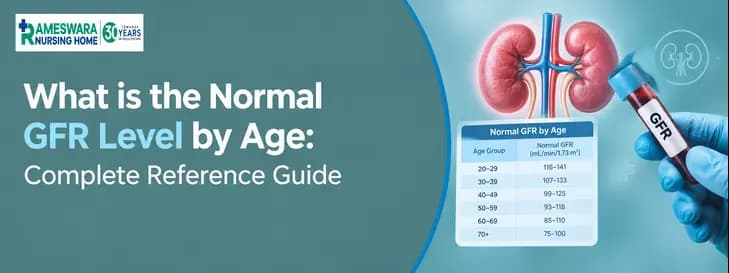
The National Kidney Foundation publishes average eGFR figures by decade, based on data from people without kidney disease. These are averages, not hard cut-offs, but they’re the clearest way to judge whether your own number fits the pattern for your age group.
| Age (years) | Average eGFR (mL/min/1.73m²) |
|---|---|
| 20–29 | 116 |
| 30–39 | 107 |
| 40–49 | 99 |
| 50–59 | 93 |
| 60–69 | 85 |
| 70 and above | 75 |
Why Does GFR Naturally Decline With Age?
Kidneys age the way most organs do. Each kidney starts adulthood with roughly a million nephrons, the filtering units that do the actual work, and that number gradually falls from around age 30–40 onward, alongside a natural reduction in kidney blood flow. Research using inulin clearance (a highly accurate, gold-standard measure of GFR) tracked this decline decade by decade and found it follows a fairly predictable downward curve in people with no kidney disease at all.
This is why context matters more than the raw number. A GFR of 68 in a 78-year-old with no protein in the urine and no other risk markers is often simply age-related and gets monitored. The identical reading of 68 in a 32-year-old is unusual enough to warrant a closer look, because it sits well below what’s expected for that age group.
GFR and the Stages of Chronic Kidney Disease
Once kidney damage is confirmed (through blood, urine, or imaging findings), eGFR is used to stage how advanced it is. This is a separate scale from the age-based averages above, it applies once disease is already suspected or diagnosed.
| Stage | eGFR range | What it generally means |
|---|---|---|
| 1 | 90 or above | Kidney damage present (e.g. protein in urine) but normal filtration |
| 2 | 60–89 | Kidney damage with mild loss of function |
| 3a | 45–59 | Mild to moderate loss of function |
| 3b | 30–44 | Moderate to severe loss of function |
| 4 | 15–29 | Severe loss of function |
| 5 | Below 15 | Kidney failure |


What Can Push GFR Lower Than Expected for Your Age?
Age accounts for part of the picture, but several other factors can lower GFR independently, some temporarily, some progressively:
- Diabetes and high blood pressure, the two leading causes of CKD in most population studies, including in India
- Dehydration or acute illness, which can temporarily lower eGFR without indicating chronic disease
- Long-term, frequent use of NSAID painkillers (such as ibuprofen or diclofenac)
- Recurrent kidney stones or urinary tract infections
- A family history of polycystic kidney disease or other inherited kidney conditions
- Obesity and smoking, both independently linked to faster kidney function decline
Symptoms That Often Show Up Only After GFR Has Already Dropped
Chronic kidney disease is frequently symptom-free in its early stages, which is part of why routine testing matters more than waiting to “feel” unwell. When symptoms do appear, they can include:
- Swelling in the ankles, feet, or around the eyes
- Foamy or unusually coloured urine
- Persistent fatigue or low energy
- Noticeable changes in how often you urinate
- Poor appetite, nausea, or muscle cramps
- Blood pressure that’s become harder to control
None of these symptoms confirm kidney disease on their own, but any combination of them, alongside a below-range eGFR for your age, is a reasonable prompt to get a repeat test and a proper consultation rather than wait it out.
The Real Gap Isn’t the Test; It’s What Happens After
An eGFR check is inexpensive and requires nothing more than a routine blood draw, most diagnostic labs in India already run it automatically alongside a basic metabolic panel. The harder part is what comes next.
A 2026 Parliamentary Standing Committee report on CKD in India flagged a shortage of nephrologists nationwide, including district-level hospitals with zero sanctioned nephrology posts, and estimated that ongoing CKD management can cost a family ₹2–5 lakh a year even before dialysis begins.
For most people, the missing piece isn’t awareness that GFR exists, it’s having a hospital nearby that can run the test, read it correctly against age-based ranges, and loop in the right specialist without turning a routine result into a weeks-long referral chase across the city.
Where Should You Get Your GFR Checked and Followed Up in Kolkata?
This is one of the most common follow-up questions once someone actually sees a below-range number on a report, so it’s worth answering directly rather than in passing.
Does a general hospital handle kidney concerns properly, or do I need a dedicated nephrology-only centre?
For an eGFR reading, a first consultation, or ongoing monitoring, most patients don’t need a super-specialty kidney hospital, they need a hospital that can draw the sample, interpret it correctly against age-based ranges, and bring in a nephrologist or urologist if the number is genuinely outside the expected range.
Kidney concerns also rarely show up in isolation; they’re commonly tangled up with blood pressure and blood sugar.
That’s the practical case for a multi-specialty setup: Rameswara Healthcare’s Urology & Nephro department sits alongside its Medicine, Cardiology and Endocrinology teams under one NABH-accredited roof in Ultadanga, Kolkata, which avoids the back-and-forth of separate clinics for what is often one connected picture.
What does Rameswara Healthcare specifically offer for kidney-related care?
- 35+ years of continuous multi-specialty service in Kolkata, with an established OPD and inpatient base
- NABH accreditation from the National Accreditation Board for Hospitals & Healthcare Providers, an independently verified quality and patient-safety standard, not a self-assigned label
- In-house pathology and diagnostics, so creatinine and eGFR results are processed on-site rather than sent out to a third-party lab
- A dedicated Urology & Nephro specialty, working alongside General Medicine, Cardiology and Endocrinology for patients whose kidney numbers are linked to blood pressure or diabetes
- 24/7 emergency and critical-care support for the cases where a kidney concern shows up alongside another acute issue
- 50+ beds across general, semi-private and private wards for admission or short-stay follow-up when it’s needed.
Simple Habits That Support a Healthy GFR at Any Age
- Stay adequately hydrated, without over-correcting into excessive fluid intake
- Keep blood pressure within the range your doctor recommends, typically under 130/80 if advised
- Manage blood sugar consistently if you have diabetes or prediabetes
- Avoid routine, long-term use of NSAID painkillers unless a doctor has specifically approved it
- Get an annual creatinine/eGFR check after age 40, or earlier if you have diabetes, hypertension, or a family history of kidney disease
- Avoid smoking, which is independently linked to faster kidney function decline
Conclusion
A “normal” GFR is a moving target that shifts with age, which means the number on your report means less on its own than it does alongside your trend over time, your blood pressure, and whether there’s protein in your urine.
Test regularly, especially past 40, or earlier with diabetes, hypertension, or a family history of kidney disease, read your result against the age band it actually belongs to rather than a flat “90 is normal” rule, and get a repeat reading before drawing conclusions from a single low number.
For Kolkata residents, and for patients planning a hospital visit to the city, that kind of test-to-consult continuity is available locally at NABH-accredited, multi-specialty centres such as Rameswara Healthcare.
Chat with Rameswara Healthcare’s care team on WhatsApp, they can help you book the right specialist and explain what your report means before your visit.
Medical Disclaimer: This article is for general informational purposes only and does not constitute medical advice, diagnosis, or treatment. GFR and eGFR values, reference ranges, and CKD staging can vary between laboratories and individuals. Always consult a qualified physician or nephrologist, such as the specialists at Rameswara Healthcare, to interpret your own lab results and determine an appropriate course of action.